SHOT Clubhouse Presents
Coach & Player Resource Guide
11 June – 19 July 2026 · USA · Canada · Mexico
Free for schools and grassroots clubs · Share freely · Tag us: @ShotClubhouse
shotclubhouse.com/world-cup-2026
How to Use This Pack
01
For Schools
Print the 48 team cards. Every student draws a team. Follow the real World Cup. Award points for completed challenges and posts tagged @ShotClubhouse. Hold your school final on 19 July.
02
For Coaches
Use the 6 session plans – 2 per age group (U5s, U13s, U16s). Each is built around an iconic World Cup moment. The skill, the story, and the drill are designed to be inseparable.
03
For Players & Families
Use the summer challenges independently. Watch the World Cup with purpose. Follow every match in the SHOT Pulse feed. Download the app and set your pre-season baseline before next season starts.
School World Cup scoring
1pt per session completed · 1pt per social post (@ShotClubhouse) · 2pts if your real-life team wins a match · 3pts if your team reaches the knockouts · Hold a school final on 19 July 2026
"Be Like Pelé" – The Joy of Scoring
The Iconic Moment
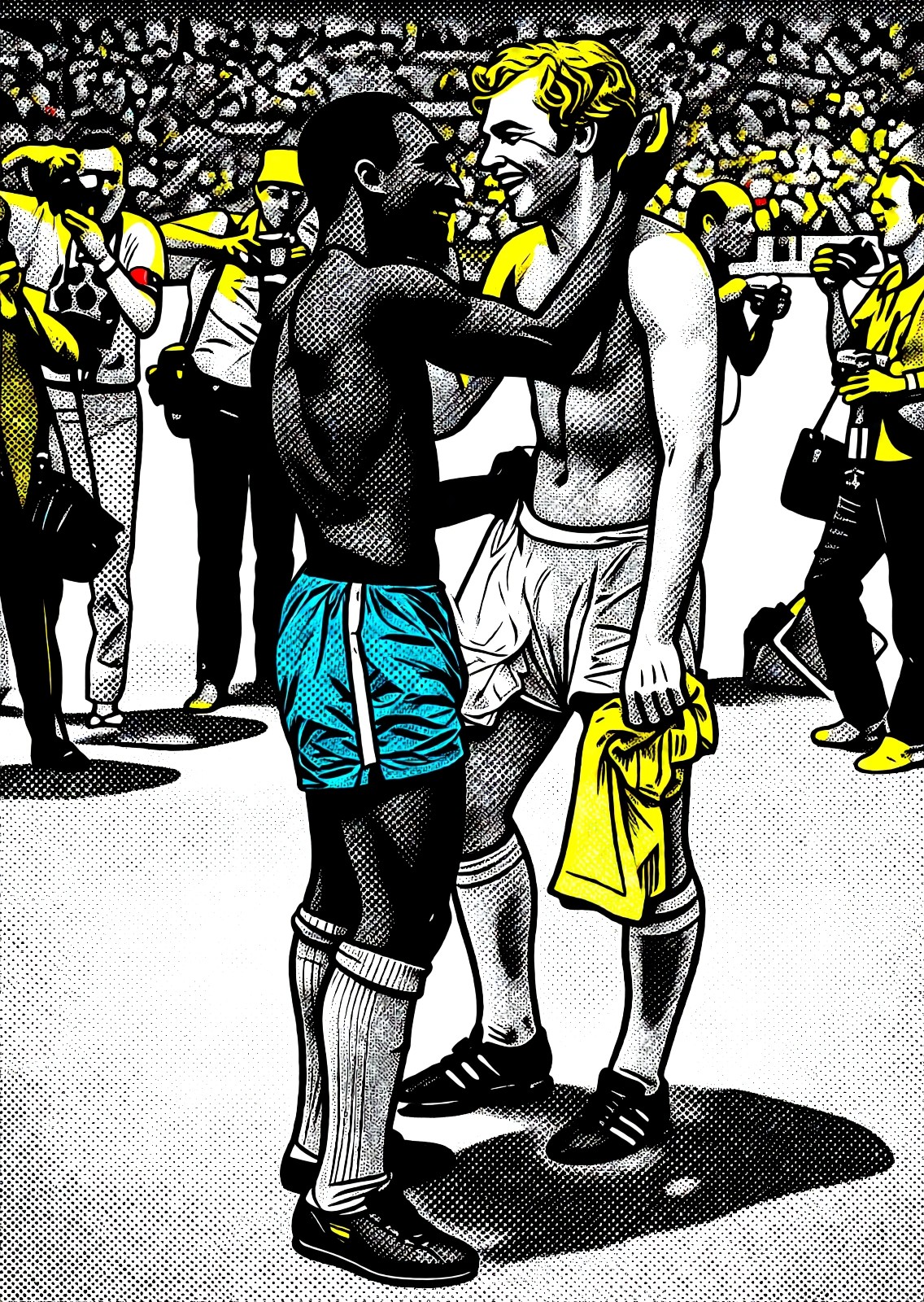
Pelé, 17 years old, Brazil vs Sweden, 1958 World Cup Final
Pelé scored twice in the final, collapsed in tears after the whistle, and had to be carried off by his teammates – not because he was hurt, but because he was overwhelmed with joy. That is what football is for.
▶ Watch Pelé on YouTubeSession structure
Ball hugs · 5 min
Every child has their own ball. Sit on it. Pick it up. Roll it. Tap with each foot. Goal: zero fear of the ball.
"Show me how much you love your ball!"
Country colours · 7 min
4 coloured cones = 4 World Cup nations. Coach calls a country. Children dribble to that cone and back. Build first touches and listening.
"BRAZIL! Go to the yellow cone – GO!"
"Be Like Pelé" – free scoring · 9 min
4 mini goals in a 10×10 yard square. Everyone plays at once. Score in any goal. No teams. No rules. Just goals. Celebrate every single one loudly.
Celebrate every goal as if it's the World Cup Final winner.
Medal ceremony · 4 min
Coach calls each child's name like a stadium announcer. Child lifts their ball above their head. Everyone cheers. No losers. Every child gets their moment.
"Representing NIGERIA – the World Cup winner is... ELLA!"
Reflect →
Ask your players: "Did you enjoy it today?" That question is the foundation of everything. Download the SHOT app and start building their profiles – app.shotclubhouse.com
"Be Like Garrincha" – Dribbling and Joy
Before you start – read this to the group (2 min)
"Garrincha was born with a curved spine and legs that bent the wrong way. Doctors told his family he might never walk properly. He grew up with no shoes and no proper ball in a tiny town in Brazil. He became a World Cup winner – in 1958 and again in 1962. Brazil never lost a World Cup match when Garrincha played. He did not dribble because he was told to. He dribbled because he loved it. Today, every one of you is going to dribble with the ball. Move with it. Keep it close. Love it."
The Iconic Moment · 1962 World Cup
Garrincha vs England – the most joyful dribbler football has ever seen
At the 1962 World Cup, Garrincha dribbled past defenders so easily he sometimes stopped and waited for them to come back – then did it again. His legs bent in ways defenders had never seen before. He did not just beat players. He made them look around, confused. Pelé called him "the most joyful player I ever played with." He played football like it was the best thing in the world. Because to him, it was.
▶ Watch Garrincha on YouTubeCommon errors to correct
Error: Kicking the ball too hard – it runs away
Fix: "Small tap. Like the ball is made of glass."
Error: Eyes down, only watching the ball
Fix: "Eyes up! Where is the gate? Where is your friend?"
Error: Stopping dead at every cone
Fix: "Do not stop. Touch it around the cone and keep moving."
Error: Only using one foot
Fix: "Try the other foot. Any touch counts. Garrincha used both."
Progressive session structure
My ball · 5 min
Setup: Every child has one ball. Free space, no cones.
Task: Walk anywhere with the ball, touching it gently with each step. No kicking. Tap it with the left foot, tap it with the right foot. Sit on it. Roll it in a circle. Pick it up. This is your ball. Get to know it.
Key coaching point: Watch for children who kick the ball away and chase it. Demonstrate: "Like this – small touch, keep it right by your foot. The ball stays close to you like a friend."
"Show me how much you love your ball. Give it a name!"
Follow the leader · 5 min
Setup: Coach dribbles with their own ball. All children follow with their ball.
Task: Coach makes gentle turns, big curves, slow direction changes. Children copy. No running yet – just walking and turning. Progress: speed up slightly for the last minute.
Key coaching point: Praise every child who keeps the ball close during a turn: "Did you see how ELLA kept it right by her foot when she turned? That is the Garrincha secret. Small touches."
"Keep your ball as close as your shadow."
"Through the gates" · 8 min
Setup: Scatter 8–10 cone gates (pairs of cones, 1 yard wide each) randomly across the space. Every child has a ball.
Task: Dribble through as many gates as possible in 90 seconds. Coach counts aloud as each child passes through a gate. Stop. Coach announces the combined team total. Rest 30 seconds. Try to beat the total together.
Key coaching point: Make it a team total, not individual competition. "Last time we got 28 gates. Let us get 35 this time!" This removes pressure and maximises every child's touches.
"Pick your next gate before you go through the one in front. Always looking!"
Dribble to goal · 5 min
Setup: 4 mini goals at the edges of the space. All children with their own ball.
Task: Score by dribbling all the way to the goal and stopping the ball on the line. No shooting – must dribble right up to it. Forces close control all the way to the target. Score in any goal.
Key coaching point: Celebrate every goal like Garrincha would – arms up, huge smile, no running away. No special celebration for the child who scores most. Every goal is equally brilliant.
"Dribble ALL the way. Do not shoot from far. Walk it in."
Show your best move · 2 min
Sit in a circle. Each child stands up and shows one move they tried today. Could be a tap left-right, a turn, stepping over the ball, anything. The group claps for each one.
Coach closing line: "Garrincha never stopped smiling when he played. Today you all moved with the ball. That is how it starts."
"Garrincha just smiled. He knew he would do it again."
Reflect →
Ask your players: "Did you enjoy dribbling today?" One answer is all you need. Build their long-term development profile in the SHOT app – app.shotclubhouse.com
"The James Rodríguez Volley" – Chest Control and Striking
Before you start – read this to the group (2 min)
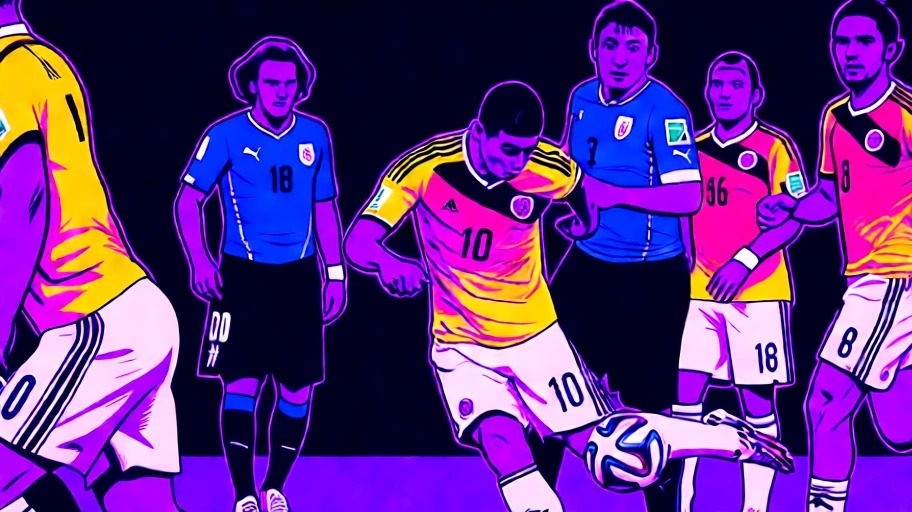
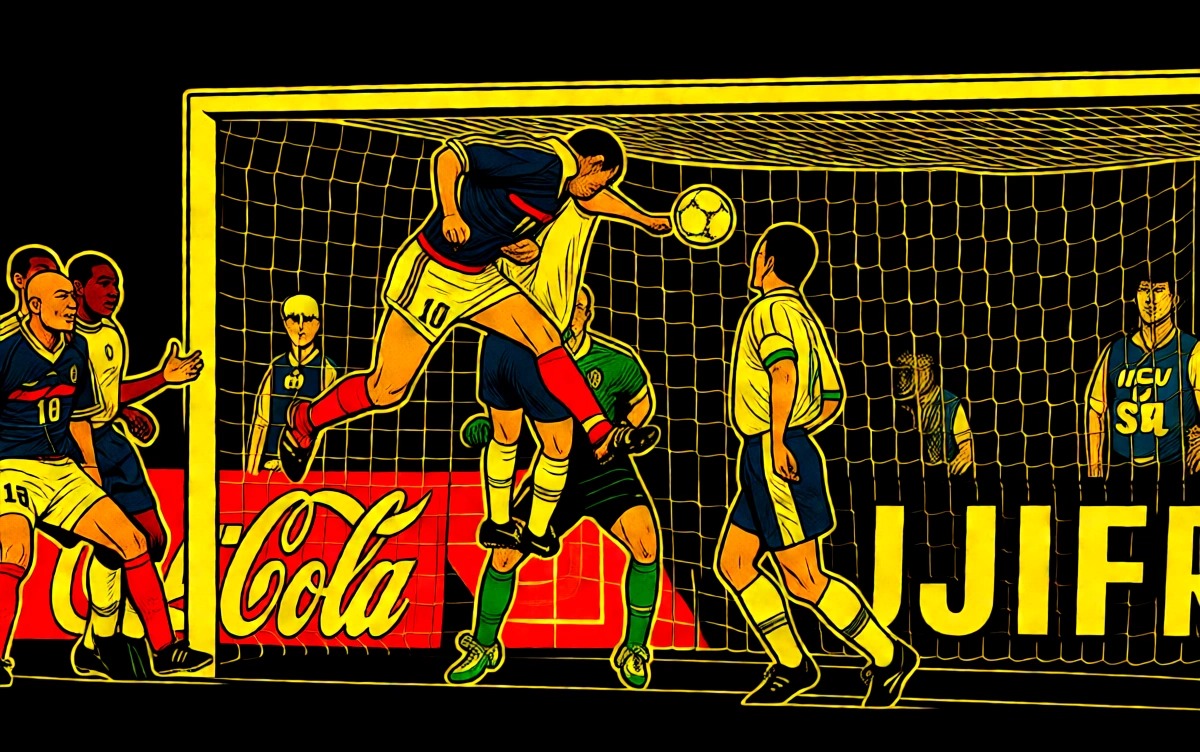
"In 2014, James Rodríguez was 22 years old, playing in his first World Cup. A cross came through the air. He controlled it on his chest – soft, cushioned – watched it fall, and before it hit the ground, drove it with the outside of his left foot into the top corner. The goalkeeper didn't move. FIFA voted it Goal of the Tournament. Today you're going to learn the two things that made it genius: control quality and decision speed."
28th minute · Colombia vs Uruguay · Estádio Mineirão · June 2014
The volley that silenced a stadium and won FIFA Goal of the Tournament
The cross arrived in the air. Rodríguez controlled it on his chest, watched it drop, and drove it with the outside of his left foot into the top corner before it hit the ground. The goalkeeper didn't move. James was 22. Playing his first World Cup. Two things made it genius: the control quality and the decision speed. He committed to the shot before the ball left his chest. No hesitation.
▶ Watch the goal on YouTubeCommon errors to correct
Error: Chest too tense (ball bounces off)
Fix: "Soft chest. Relax. Let it stick."
Error: Taking a second touch before striking
Fix: "The Rodríguez rule: no bounce. If it bounces, it doesn't count."
Error: Looking down instead of at the ball
Fix: "Watch the seams on the ball. Right onto your chest."
Error: Slowing before striking
Fix: "Commit to the shot the moment you cushion it."
Progressive session structure
Activation: face-to-face chest control · 8 min
Setup: Pairs, 6 yards apart, facing each other.
Task: Player A underarm-throws the ball to chest height. Player B controls it on their chest, lets it fall to their feet, rolls it back. 10 reps each.
Progression: Player B controls with chest and lets it drop to the floor without catching – get used to the ball leaving the chest and falling.
Key coaching point: "Soft chest. Don't tense up. Relax your shoulders. Let the ball stick."
"Watch the ball all the way to your chest. Every time."
Development: side-feed with body turn · 10 min
Setup: Player A stands to the SIDE (8 yards). Player B stands facing a goal or target.
Task: A feeds the ball at chest height from the side. B controls on chest, opens their body (turns toward goal), lets the ball drop, short pass back to A.
Why this matters: James Rodríguez received the ball from the side, not face-on. The chest had to cushion it AND redirect the body toward goal.
Key coaching point: "Open your body BEFORE the ball arrives. If you're still square when it hits you, you've lost a second."
"Chest = redirect. Not just control – aim yourself at the same time."
"The Rodríguez sequence" – chest, drop, strike · 15 min
Setup: Server on the side (8 yards), player B stands 12 yards from goal/wall target.
Task – THE JAMES RODRÍGUEZ MOMENT: A chips/tosses shoulder-height from the side. B: (1) chest → (2) watch it drop → (3) drive with laces before it hits the ground toward the target. RULE: ball must NOT touch the floor. One touch of chest, then strike.
Start close (6 yards from target), extend to 12 yards as technique improves.
Challenge: "5 clean strikes in a row – clean = ball hits target before bouncing."
Note for coaches: Most players will fail initially. That's fine. The session is about understanding the difficulty of what Rodríguez did. Every clean strike is an achievement.
"Commit to the shot the moment you cushion it. No second thoughts."
Application: 4v4 "volleys count double" · 20 min
Setup: 4v4 in a 25×20 yard area, one goal each end. Normal rules except: any goal scored without the ball touching the ground = counts as 2 goals.
What happens naturally: Players start chipping and crossing to create chest-control moments for each other. Attackers position themselves to receive the ball in the air.
Stop play at 10 minutes: "What type of cross does your striker need to chest it and volley? From where? At what height? Ask them right now." Give 2 minutes for teams to discuss, then restart.
Coaching opportunity: When a volley goal is scored, celebrate it loudly. When a player takes an extra touch before shooting, ask: "What would Rodríguez have done there?"
"The cross matters as much as the finish. Set your teammate up."
Reflection · 7 min
Sit in a circle. Coach asks: "What was the hardest part? Controlling it? Committing to the shot? Timing the drop?"
Each player says: "My best chest control moment was when..." and "Next time I'll..."
Coach closing line: "James Rodríguez was 22 in his first World Cup, under pressure, on the biggest stage. He didn't hesitate. The control quality and the decision speed – both of those get better with every session like this one."
"James didn't hesitate. Neither should you."
Reflect →
Ask players: "How confident did you feel receiving the ball in the air? Did you commit to the shot quickly?" Build their development profile in the SHOT app – app.shotclubhouse.com
"Maradona's Goal of the Century" – Running with the Ball at Pace
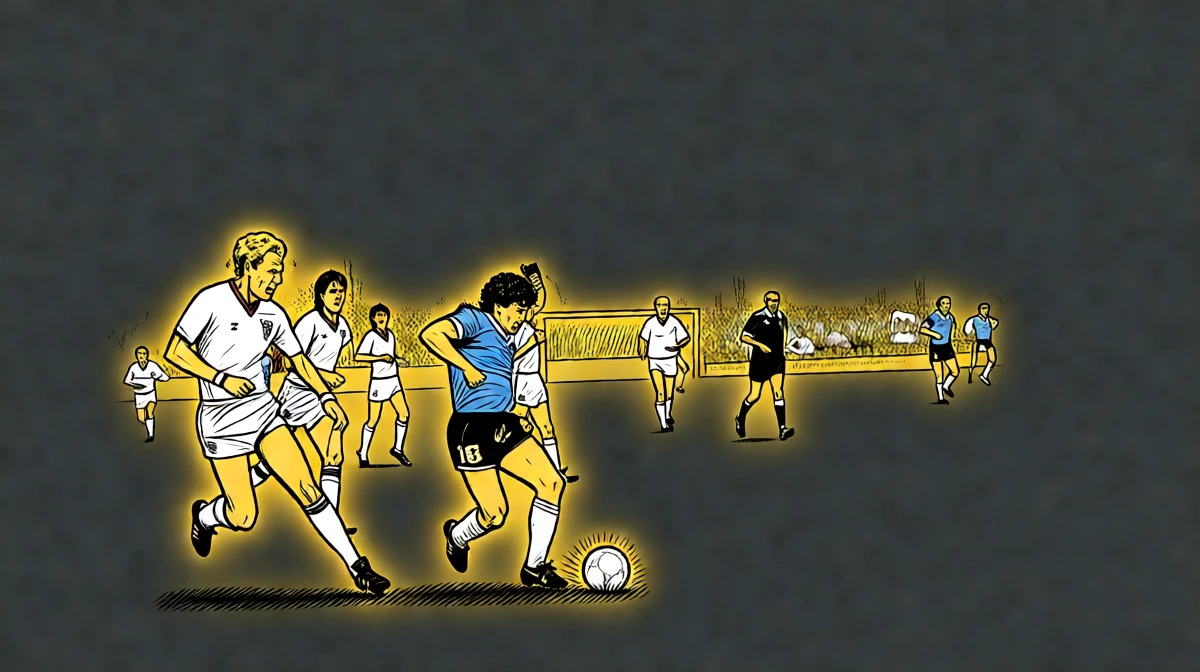
55th minute · England vs Argentina · Azteca Stadium · 22 June 1986
60 yards. 5 defenders. 1 goalkeeper. 11 seconds.
Maradona picked up the ball in his own half and ran. He beat every single England player. He never slowed down. Never hesitated. He said afterwards: "I felt like I was running so fast the wind was blowing me." That is courage in its purest football form.
▶ Watch the goal on YouTubeBefore you start – read this to the group (2 min)
"Mexico 1986. Argentina versus England. The quarter-final. Maradona picks up the ball in his own half. There are five England players between him and the goal. A normal player passes. Maradona runs at all five. He beats them. He beats the keeper. He scores. The whole run takes eleven seconds. Bobby Robson said it was the greatest goal he had ever seen. What made it possible was one thing: the ball stayed so close to his foot it was almost part of his body. Today we are going to work on exactly that."
Common errors to correct
Error: Ball too far ahead – player chases it
Fix: "Short touches. Never more than one pace from your foot."
Error: Slowing down when approaching a cone
Fix: "Accelerate through the cut, not after it. The cut IS the acceleration."
Error: Head down the entire run
Fix: "Scan before you receive. Use peripheral vision. Maradona looked up between touches."
Error: Hesitating between the first and second defender
Fix: "The momentum is your advantage. Stop and it's gone. Run through, not to."
Progressive session structure
"5 defenders" cone slalom · 10 min
Setup: 5 cones per player in a diagonal zig-zag, 3 yards apart. Goal or target 5 yards beyond the last cone. Players run in individual lanes simultaneously.
Task: Run 1 – slow, focus on keeping ball within one pace. Run 2 – match pace, maintain close control. Run 3 – full pace. Progress: on run 3, coach calls "LEFT" or "RIGHT" at the final cone – player must cut that way before shooting.
Key coaching point: If the ball gets two paces ahead, stop and reset. The rule is absolute. Short touches with the outside of the foot. "Keep the ball close. It should feel like it's attached."
"Keep the ball close. Short, quick touches. Maradona never lost it from his feet."
Feint and cut – 1v0 technique work · 8 min
Setup: One cone per player at 5 yards. Each player with a ball.
Task – learn the feint sequence: (1) Approach the cone at pace, (2) shape the body as if going left (shoulder dips, hips open left), (3) at the last moment cut right with the outside of the right foot, (4) accelerate away. Then reverse – shape right, cut left. Combine two feints in a row before finishing with a strike on goal.
Key coaching point: The feint must be convincing. A tiny shoulder lean that fools nobody does not count. "Exaggerate first, then refine. Show them one way, go the other – and mean it."
"The feint has to MEAN something. Make them believe you're going left."
"The Maradona Run" – 1v2 overload · 15 min
Setup: Player starts at halfway with the ball. Two defenders stand 5 yards ahead, 2 yards apart. Goal at the end.
Task: Beat both defenders and score. No teammates. If the ball is lost: sprint back immediately to defend for the next player in line. This is the consequence that keeps the intensity real.
Progression: Add a third defender. Then a goalkeeper. Three turns each, then rotate roles.
Key coaching point: Watch for the hesitation between defenders 1 and 2. The pause is where the ball gets taken. The momentum of the run is the advantage. "Running through defenders is harder than running to them. Don't slow down between them."
"Show them one way, go the other. No slowing down between defenders."
5v5 with "Maradona zones" · 17 min
Setup: Mark two 5×5 yard zones near the halfway line, one on each side. Normal 5v5 to full goals.
The rule: Dribble through a Maradona zone AND beat a defender inside it = your team gets an extra player for 30 seconds. Running into the zone but not beating a defender = nothing. Rewards brave, successful dribbling with a real in-game advantage.
What to watch for: Players who avoid the zones because it's risky. Name it: "Avoiding the zone is the opposite of what we spent an hour learning." Celebrate every zone entry attempt – success or not.
Key coaching point: "Running at a defender when you could pass safely is a skill. Most players never build it because they stop trying."
"Who's brave enough to run at a defender? That is the only question."
Reflection · 5 min
Sit in a circle. Coach asks: "What was your best run today? When did you feel like Maradona – even for two seconds?"
Each player answers: "The moment I felt bravest was when..."
Coach closing line: "Maradona didn't ask permission to run at those five defenders. He just ran. That bravery is a skill. And it gets better every time you choose the hard option."
"Courage in football isn't being fearless. It's running anyway when you are."
Reflect →
Ask players: "Did you take on a defender today when you could have passed safely?" That is the real question. Track their courage and development in the SHOT app – app.shotclubhouse.com
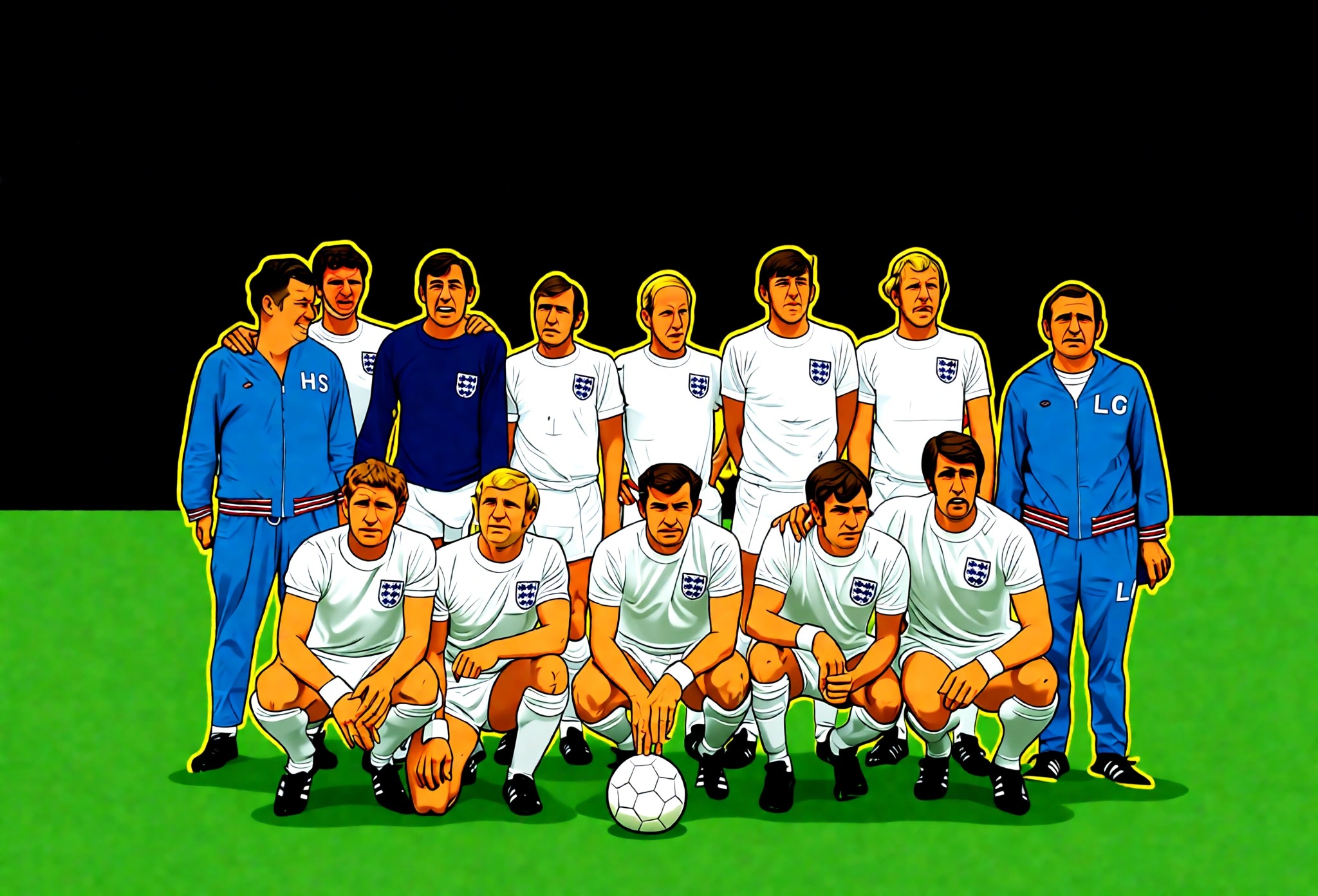
"The Bobby Moore Tackle" – Defending with Intelligence
England vs Brazil · 1970 World Cup · "the finest tackle ever made"
Jairzinho – unstoppable – bearing down on goal. Moore was the last man.
The conventional wisdom: foul him. Instead, Moore waited. He read Jairzinho's run, waited for the precise moment the ball was overextended, and took it cleanly. Not desperate. Surgical. Pelé called Moore the greatest defender he ever faced. Moore reportedly said: "Make sure you win it cleanly."
▶ Watch the tackle on YouTubeBefore you start – read this to the group (2 min)
"England vs Brazil, 1970 World Cup. Jairzinho – the most feared winger in the tournament – was running at full pace directly at Bobby Moore, who was the last defender between him and the goal. Every instinct in football says foul him, slow him down, stop the attack any way you can. Moore did not foul him. He waited. He watched Jairzinho's hips, not the ball. He waited for the exact moment the ball was slightly too far from Jairzinho's foot – then he took it. Cleanly. No foul. Pelé said Moore was the greatest defender he ever played against. Today we find out what that level of defending actually requires."
Common errors to correct
Error: Diving in too early
Fix: "Wait. Force them to make the decision. Don't make it for them."
Error: Watching the ball not the hips
Fix: "Ball is a decoy. Hips tell you where they're going a fraction before they do."
Error: Getting too close – no reaction time left
Fix: "Stay 2 yards away in the hold zone. Close only when the ball is overextended."
Error: Fouling when they do commit
Fix: "A foul here means the attacker wins. Clean only. That is the Bobby Moore rule."
Progressive session structure
Hold zone delay drill · 10 min
Setup: 10-yard channel with a goal at the end. Defender at the back, forward with ball at the front.
Task: Forward tries to reach the goal. Defender rule: CANNOT tackle for the first 3 yards. Must stay on their feet, stay roughly 2 yards from the forward, and force them wide or backwards. No lunging, no sliding, no throwing themselves at the ball.
Key coaching point: The first 3 yards are the hold zone. In that zone, the defender's only job is to read, track, and stay composed. The tackle – if it comes – comes when the ball is overextended. Watch for the urge to dive in. Name it every time: "That is not defending. That is panic."
"Your job is NOT to win the ball immediately. Your job is to control what they do."
"Read the hips" 1v1 reaction drill · 15 min
Setup: Defender and forward face each other 8 yards apart. Forward has ball.
Coached signal phase: Coach stands beside the forward, hidden from defender, signals LEFT or RIGHT with their hand. Forward goes that way. Defender reacts.
Progress to hip reading: Remove the signal entirely. Defender must read the forward's hip angle only – not the ball, not the shoulders. The hips rotate fractionally before the body follows. That is the tell.
Key coaching point: After 5 minutes, ask players: "When did you start reading it? What changed?" Most will say they stopped looking at the ball. That is the lesson. "The ball is a decoy. The hips never lie."
"Watch the hips. They never lie. The ball is a decoy. Hips tell the truth."
"Last man" pressure match · 20 min
Setup: 7v7 or 8v8. One designated "Bobby Moore" defender per team. Rotate the role every 5 minutes so everyone experiences it.
The rule: If the attacking team beats all other defenders and only the BM player remains, the BM gets 15 seconds for one clean tackle attempt. Clean ball win = +2 to their team. Foul = 0. Missed tackle = +1 to attackers.
What to watch for: BM players who panic. Celebrate every clean win loudly. When they foul: "Moore would not have fouled. What would Moore have done?" Make the standard explicit and public.
Key coaching point: The 15-second window is enough – but only if all three previous phases are in play: hold zone, hip reading, and patience for the overextended ball.
"You only get one chance. Read it. Time it. Win it cleanly."
Full-pace 1v1 under fatigue · 15 min
Setup: Full-length 1v1s from halfway. Forward goes at full pace. Defender must retreat, hold the zone, and win the ball cleanly before the goal line. Goalkeeper optional but adds realism.
Progression: Add fatigue. Players do 8 burpees before their defending turn. Defending intelligently when tired is harder. That is exactly when panic defending happens in matches.
Key coaching point: Compare the first two reps with the last two. Which defenders are still holding the zone when tired? Which are diving in? "Your technique in the 80th minute should look the same as in the 5th minute. That is elite defending."
"An elite defender makes the attacker wish they'd never run."
Tactical debrief · 10 min
Sit the group in a circle. Coach asks: "What did Moore do that a panicking defender wouldn't?" Take answers. Build toward: (1) he didn't dive in, (2) he watched hips not ball, (3) he waited for the right moment, (4) he took it cleanly.
Each player answers: "The hardest thing for me today was..."
Coach closing line: "Bobby Moore won that ball because he was thinking while Jairzinho was running. Jairzinho had pace. Moore had intelligence. That is the game inside the game."
"A great defender wins the ball. An elite defender makes the attacker regret running."
Reflect →
Ask players: "Did I stay composed under pressure? Did I pick the right moment to tackle?" An intelligent defender thinks first. Track their defensive development in the SHOT app – app.shotclubhouse.com
"Zidane's Masterclass" – Technical Elegance Under Pressure
Zinedine Zidane · 1998, 2002, 2006 World Cups
The player who made tight spaces look empty
Zidane was arguably the best player in every World Cup he entered. His defining characteristic wasn't pace or power – it was what he did in tight spaces. The Zidane roulette. The first touch that turned a bad ball into a good one. He once said: "I don't dribble to beat players. I dribble to find space." Every touch was purposeful. Every touch moved him somewhere better.
▶ Watch Zidane on YouTubeBefore you start – read this to the group (2 min)
"Zinedine Zidane played in three World Cups and was arguably the best player in every one. He won the Golden Ball in 1998. He was the best player at the 2006 tournament at the age of 34. His pace was not remarkable. His power was not remarkable. What was remarkable was what he did with the ball in tight spaces. Defenders surrounded him and somehow found themselves looking at his back. He once said: 'I don't dribble to beat players. I dribble to find space.' Today we learn what that means – and start to build it."
Common errors to correct
Error: First touch kills the ball dead
Fix: "Every touch should move you. A touch that stops the ball is a wasted touch."
Error: Body closed before receiving
Fix: "Open before the ball arrives. Half-turn. See what's behind you before you get it."
Error: Roulette started at full speed too early
Fix: "Slow first. You have to feel all three steps before you can join them up."
Error: Roulette used in the wrong area of the pitch
Fix: "Zidane used it in midfield, not in his own box. Pick the right moment."
Progressive session structure
First touch positioning drill · 12 min
Setup: Groups of 3 – Player A (receiver), Player B (feeder at 8 yards), Player C (passive defender 2 yards behind A).
Task: B feeds varied balls – on the ground, bouncing, at height. A must: (1) open body before ball arrives, (2) first touch moves AWAY from C (not toward them), (3) play the ball back to B. The Zidane principle: your first touch creates space; it does not kill the ball.
Progress: Make C semi-active – A must evade them using only the first touch.
Key coaching point: "Before the ball arrives, decide WHERE your first touch goes. Not how to control it – where. A touch to stop is not a Zidane touch. A touch to move is."
"Before the ball arrives, decide where your first touch goes."
"The Roulette" – technique breakdown · 15 min
Setup: Each player with a ball and a cone at 3 yards representing a defender.
Task – the three steps, slowly: (1) Approach cone, step on top of ball with right foot – weight on left foot, body turned side-on. (2) As cone "arrives" – drag ball back with right foot, pivot begins on left foot. (3) Complete 180° pivot, left foot planted, drive away at full pace with right foot.
Reps: 10 slow repetitions against cone. Then 5 reps against passive defender (standing still). Then 5 reps against semi-active defender (walking pressure).
Key coaching point: Do not move to the next stage until the previous one is clean. "Zidane did this thousands of times before the World Cup. The speed comes from repetition, not from trying to go fast before you're ready."
"Slow before fast. Zidane did this thousands of times before the World Cup."
Rondo under pressure 6v3 · 20 min
Setup: 6 possession players, 3 defenders, 15×15 yard box. Standard rondo rules.
Added rules: (1) Minimum one touch per player – no instant bounce-back passes. (2) If a player uses the roulette to escape pressure and keeps possession, their team earns 10 seconds of free possession where defenders cannot press. Rewards technical bravery with a real game reward.
What to watch for: Players who choose the easy pass under pressure every time. Ask them: "What would Zidane have done there?" Don't force roulette attempts – but celebrate every one tried, successful or not.
Key coaching point: "Every touch is a decision. Not just 'can I control it?' – but 'where does this touch put me?'"
"Every touch is a decision. Where does it put you?"
Full game – apply the session · 15 min
Setup: Full 11v11 (or adjusted to squad size). No special rules – this is the application phase. Everything from phases 1–3 should appear naturally in the match.
What to watch for: Moments where players open their body before receiving (phase 1). Moments where a first touch moves the player into space rather than killing the ball. Any roulette attempt.
Key coaching point: Stop play once only – no more. When you do, ask the group: "What did we just see there?" Get them to identify the technique themselves. Do not coach every rep. Let the match breathe.
Coach note: "Zidane played for his position. The roulette for a striker looks different to the roulette for a central midfielder. Ask players: what does YOUR version look like?"
"Zidane played for his position. What does YOUR version of this look like?"
Reflection · 8 min
Sit the group in a circle. Coach asks: "Where did your first touch move you somewhere better today? Give me one example."
Each player answers: "My best touch today was in the [phase/game] when I..."
Coach closing line: "Zidane said every touch was a decision. For the next month, every time you receive the ball, ask yourself before it arrives: where is this touch going? That question alone will make your first touch 20% better by the start of next season."
"One question before every touch: where is this touch going?"
Reflect →
Ask players: "Where did your first touch move you somewhere better today? What does your version of the roulette look like in your position?" Start tracking in the SHOT app – app.shotclubhouse.com
The Five Corners – World Cup Edition
The SHOT app uses a Five Corners framework to track athlete development. Use the World Cup to think about your game across all five areas – then download the app and start building your profile before next season.
Technical
Ball control, first touch, passing, shooting, dribbling. Watch for: the quality of the first touch under pressure. Ask yourself: "What would MY version of that skill look like on this stage?"
Psychological
Confidence, composure, resilience, mental strength. Watch for: who keeps their head when 1-0 down. Penalty shootouts. Comebacks. Ask: "How do I respond when things go against me? Could I do what they just did?"
Physical
Stamina, speed, strength, fitness. Watch for: who is still running in the 85th minute. Use this six-week tournament as a fitness benchmark. Ask: "How is my fitness compared to where I was at the start of the summer?"
Social
Teamwork, communication, leadership. Watch for: who organises teammates, who calls for the ball, who encourages. Ask: "Am I making myself heard in training? Who would I point to if my coach asked who communicates best in my team?"
Personal
Self-reflection, identity, purpose, growth. Watch for: why each player seems to love the game. Ask: "Do I know WHY I play? What do I want to be better at by the time this tournament ends?"
Get the SHOT app. It's free.
Follow the World Cup in Pulse. Run your club. Track athlete development across all Five Corners. Download now – iOS, Android, or web.
app.shotclubhouse.com
Take this further
Create your club in SHOT Clubhouse
This resource pack gives you the sessions. SHOT Clubhouse gives you the platform. Follow every World Cup match in Pulse – live scores, previews, reviews, and original content. Create your club, invite players and parents, run evaluations, and track athlete development across all Five Corners. All summer. All season.
Club & team management
Create your club, build squads, manage your complete admin.
Athlete development pathways
Run evaluations, track Five Corners development, build athlete profiles all season.
Invite players & parents
Everyone joins in seconds. All data visible in real time.
Athlete development data
Every session this summer becomes a baseline for next season.
Free to start. Available on iOS, Android, and web.
app.shotclubhouse.com
Iconic Celebrations
Football celebrations are art. Here are eight you can learn, practise, and recreate. Film yours and tag @ShotClubhouse.
The Klinsmann Dive
Germany · 1994Klinsmann was accused of diving – so when he scored at the 1994 World Cup, he deliberately dived to celebrate. The whole team piled on top.
Try it: Score. Sprint at teammates. Dive forward dramatically.
The Circle Dance
Senegal · 2002After beating France, Senegal formed a circle and danced the Coupé Décalé. One of the most joyful celebrations in World Cup history.
Try it: Circle. Take turns dancing in the middle for 3 seconds each.
The Zidane Point
France · 1998After scoring in the World Cup Final, Zidane simply pointed skyward. No jumping. No sliding. One quiet, dignified gesture. Sometimes less is everything.
Try it: Score. Stop. Breathe. Point one finger to the sky. Walk away.
The Suárez Sprint
Uruguay · 2010Suárez celebrates by sprinting to the corner flag as fast as humanly possible – as if trying to run away from his own joy.
Try it: Score. Sprint to the nearest corner as fast as you can.
The Rock-a-Baby
Brazil · 2002Ronaldo (R9) cradled his arms at the 2002 World Cup honouring his newborn son. Imitated by players worldwide for years.
Try it: Score. Cradle your arms and rock them gently.
The Haaland Meditation
Norway · 2020sHaaland sits cross-legged in the middle of the pitch, eyes closed. The contrast – the most explosive athlete alive, completely still.
Try it: Score. Sit cross-legged. Eyes closed. Two seconds. Get up.
The Japan Clean-Up
Japan · 2022After every Japan match in 2022, Japanese fans cleaned the entire stadium. This became their most powerful celebration. More memorable than any dance.
Try it: End of session – everyone tidies the pitch for 60 seconds.
The Archery
Various · 2010sMultiple players have used the archery celebration – mime drawing a bow and releasing an arrow. Clean, clear, memorable. Works for any age.
Try it: Score. Draw your bow. Aim. Release. Arrow flies.
Summer Challenges
Off-season doesn't mean switched off. One challenge per World Cup week. Each is tied to an iconic player or moment.
Under 5s – The Pelé 21 Challenge
Inspired by Pelé, who practised with rolled-up socks in the streets of Bauru, Brazil
Pelé didn't have a proper ball until he was 9. He played barefoot on concrete. He fell in love with the ball before he fell in love with football.
📲 Download the SHOT app and start building your development profile before the new season – app.shotclubhouse.com
Under 13s – The Maradona Cone Trail
Inspired by Maradona's Goal of the Century, Mexico 1986
📲 Track your improvement week by week in the SHOT app and start next season with real data – app.shotclubhouse.com
Under 16s – The Zidane First Touch Diary
Inspired by Zinedine Zidane – every touch was a decision
📲 Track your first touch improvement week by week in the SHOT app – app.shotclubhouse.com
For Parents – Watch Like a Coach
You don't need to know football to ask the right questions
Ask one of these after each match you watch together. Listen. Don't judge the answer.
📲 Download the SHOT app – parents can follow their child's development and stay connected with the club all season – app.shotclubhouse.com
Key Match Calendar
Key fixtures with development prompts. Add the .ics file to your calendar at shotclubhouse.com/world-cup-2026
The .ics calendar includes post-match reflection reminders that fire 2 hours after kick-off – so you log while it's fresh.
| Date | Match | Group | Reflection prompt |
|---|---|---|---|
| 11 Jun | Mexico vs South Africa | Group A | Who presses first? What triggers it? Technical. |
| 13 Jun | USA vs Paraguay | Group D | Hosts under pressure. Composure. Psychological. |
| 14 Jun | Haiti vs Scotland | Group C | Scotland's opener. First touch under pressure. Technical. |
| 14 Jun | Germany vs Curaçao | Group E | Germany pressing triggers. Psychological. |
| 15 Jun | Spain vs Cabo Verde | Group H | Spain's positional play. Where is the spare man? Technical. |
| 16 Jun | France vs Senegal | Group I | 2002 rematch. Defensive shape. Psychological. |
| 17 Jun | Argentina vs Algeria | Group J | Watch Messi drop deep. Technical. |
| 17 Jun | England vs Croatia | Group L | England's defensive shape. When do they press? Technical. |
| 19 Jun | Scotland vs Morocco | Group C | Wide 1v1s both ways. Bravery on the ball. Technical. |
| 20 Jun | Brazil vs Haiti | Group C | Brazil wing combinations. Technical. |
| 23 Jun | England vs Ghana | Group L | Kane's movement between the lines. Technical. |
| 24 Jun | Scotland vs Brazil | Group C | The big one. Who keeps their head? Psychological. |
| 27 Jun | Panama vs England | Group L | Set-pieces. All Five Corners. |
| 28 Jun | Round of 32 begins | Knockout | Predict winner before kick-off. Check after. |
| 4 Jul | Round of 16 begins | Knockout | How does the losing team chase the game? Tactical. |
| 9 Jul | Quarter-finals begin | Knockout | Who steps up? Psychological. |
| 14–15 Jul | Semi-finals | Knockout | Log all Five Corners. One player per corner. |
| 18 Jul | Third place play-off | Knockout | Strength after heartbreak. Psychological. |
| 19 Jul | World Cup Final | Final | Rate all Five Corners. Set your season target. |
48 Team Cards
Print and cut out. Draw your team. Complete the challenge. Tag @ShotClubhouse with your results. Download the SHOT app at app.shotclubhouse.com
The development platform for grassroots football
Free to join · Built for athletes, coaches, clubs, and families
You've got the sessions.
Now build your club.
Create your club in SHOT Clubhouse. Invite your players and parents. Follow the World Cup in Pulse. Run your whole season — evaluations, Five Corners tracking, player development pathways, club admin — in one place.
Club & team management
Create your club, build squads, manage complete admin from one dashboard.
Athlete development pathways
Five Corners evaluations. Session logging. Data that follows the athlete all season.
Players & parents connected
Invite your whole squad. Parents see their child's development. Coaches see everything.
Free to start. Free forever for grassroots.
Available now on web, iOS, and Android.
app.shotclubhouse.com
Create your club in 2 minutes
shotclubhouse.com/world-cup-2026 · @ShotClubhouse · #WorldCup2026 · #SHOTClubhouse
Share this pack freely · Tag us when you use it