
Jobs this piece does
- Tell the origin story
- Show why care does not scale by memory
- Explain coach tooling
Five girls
SHOT did not start in a pitch deck. It started with five girls on a pitch, and I want to tell that story properly once, because I usually give people the two-line version and the two-line version misses the point.
Years ago I set up a not-for-profit to coach girls' football, because my daughter wanted to play and there was nowhere for her to do it. First session: five girls. I remember thinking that if we could just hold on to those five, it would be worth doing.
Then it was twenty. Then a hundred. Then hundreds of boys and girls every single week. Some had disabilities. Some were carrying mental health struggles that no eight-year-old should be carrying. Most just wanted to play football, and had somehow reached an age where nobody had made that easy.
Growth like that sounds like a success story, and in one sense it was. In another sense it nearly broke me, and understanding why is the entire reason SHOT exists.
Here is what scaling on-the-field coaching actually looks like. Every new group of twenty kids needs a coach. The coach is a parent you roped in because no one else would do it. They get a short digital course, a safeguarding module, a first aid session, and then they are handed a squad and left to it. Fifteen kids, fifteen bibs, fifteen balls, off you go. The qualification is a licence to start learning, and we treat it like a finish line.
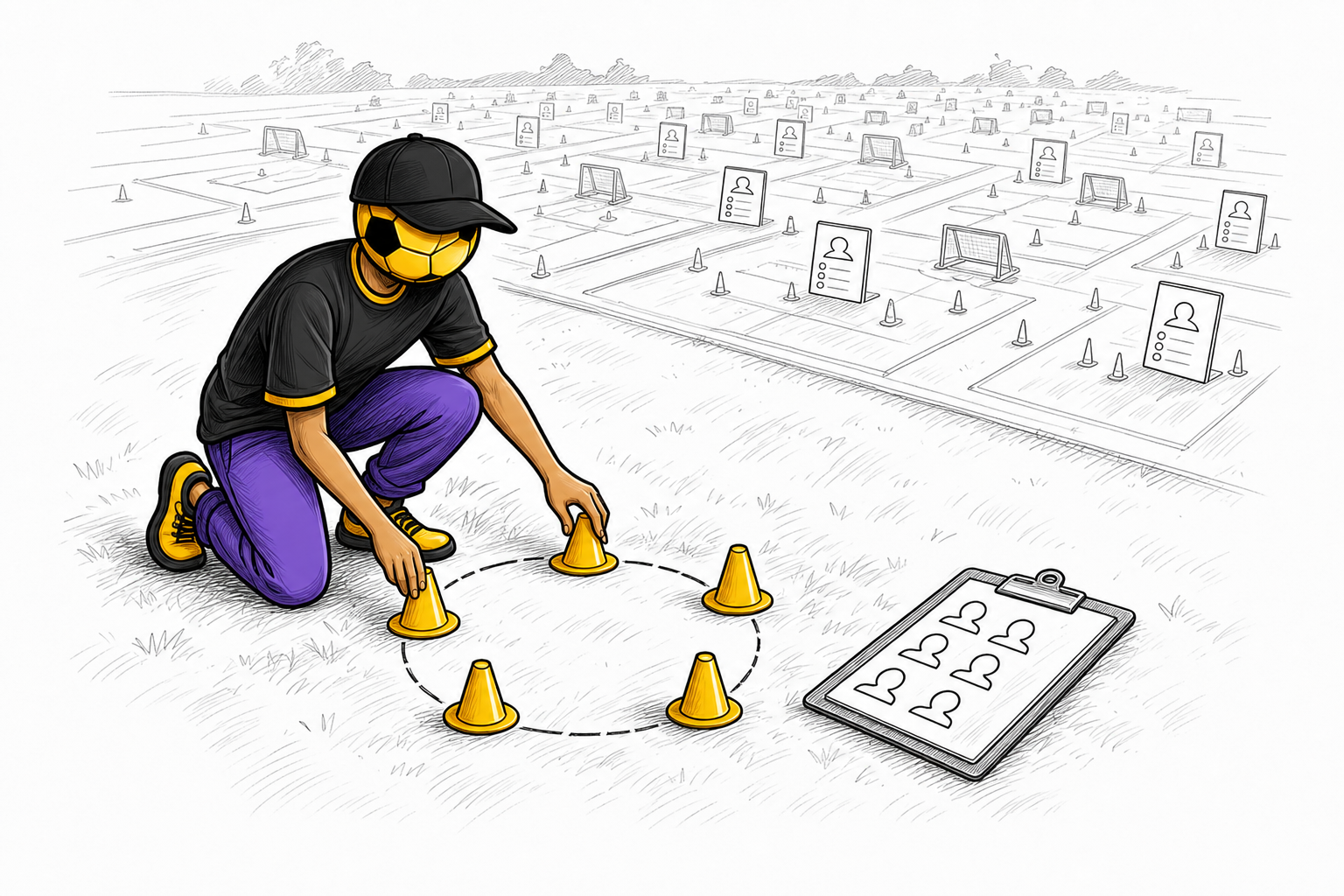
And every kid in every one of those groups is different. The girl who needs pushing and the girl who needs protecting look identical on a register. The boy with autism who needs to know the plan before he arrives. The kid whose confidence collapsed at a new school and shows it by going quiet on the pitch. I could hold maybe forty of those stories in my head. At hundreds a week, the thing that made the whole project work, actually knowing each child, became mathematically impossible. Not hard. Impossible.
The system's answer to that impossibility is to stop seeing individuals and start seeing groups. Sessions delivered, numbers on a register, teams entered. And the kids feel it. The moment sport stops seeing them as a person is the moment they start drifting.
The numbers say this is not just my story. Women in Sport, from a survey of over 4,000 girls, found 43% of girls who describe themselves as sporty disengage from sport after primary school, against 24% of boys; that is around 1.3 million teenage girls. The Youth Sport Trust found girls' enjoyment of PE falls from 86% at ages seven to eight to 56% by fourteen to fifteen. The drop is not because sport got worse. It is because the seeing stopped.
So the problem I could not solve on grass became the problem I decided to solve in software. Not to replace the coach. You cannot replace the coach, and anyone selling you that is lying. The point is to give every roped-in parent volunteer what an academy coach takes for granted: a structure for each session, a way to understand each child, a record of who this kid is and where they are, that follows them instead of resetting every season.
The girl who needs protecting gets seen. The boy who needs the plan in advance gets his plan. The volunteer coach with fifteen bibs stops guessing. That is it. That is the company.
People sometimes ask when I decided to move from charity to business, as if it was a graduation. It was not. It was an admission of failure, the useful kind. I failed to scale care by working harder, because care does not scale through one person. It scales through tools that let a thousand ordinary volunteers care as precisely as one obsessive founder did when it was just five girls and he knew everything about all of them.
Those five girls are young women now. Some still play. What I owe them is a system where the five hundredth kid gets seen as clearly as they were.
That is what we are building at shotclubhouse.com.
Read more from SHOT.