
Jobs this piece does
- Give coaches a 30-second plan
- Turn wet sessions into coached sessions
- Make progress visible week to week
The wet Sunday session plan
It's 9am on a Sunday. It's raining, properly raining, the kind where the cones float. You've got a car park full of parents who'd rather be anywhere else, a squad of kids in various states of awake, and forty-five minutes to fill.
I've stood there two ways in my coaching life. Let me tell you about both, because the difference between them is about thirty seconds, and those thirty seconds are the difference between improvising and coaching.
Version one: no plan. I've had a busy week, I'll wing it. We start with a jog because that's what you do. Then a drill I half remember, which lasts until it falls apart, so, four minutes. Then the sacred words every unprepared coach eventually says: "right, let's just have a match." And the match is fine. The kids run about. The confident ones dominate the ball, the quiet ones orbit the game without ever quite entering it, I shout "unlucky!" and "well done!" at semi-random intervals, and at 9.45 everyone goes home wet.
Here's the uncomfortable question I eventually had to ask myself about those mornings: what did any individual child get better at today? I couldn't answer it. Not because nothing happened, but because I hadn't decided what was supposed to happen. I wasn't coaching. I was supervising weather.
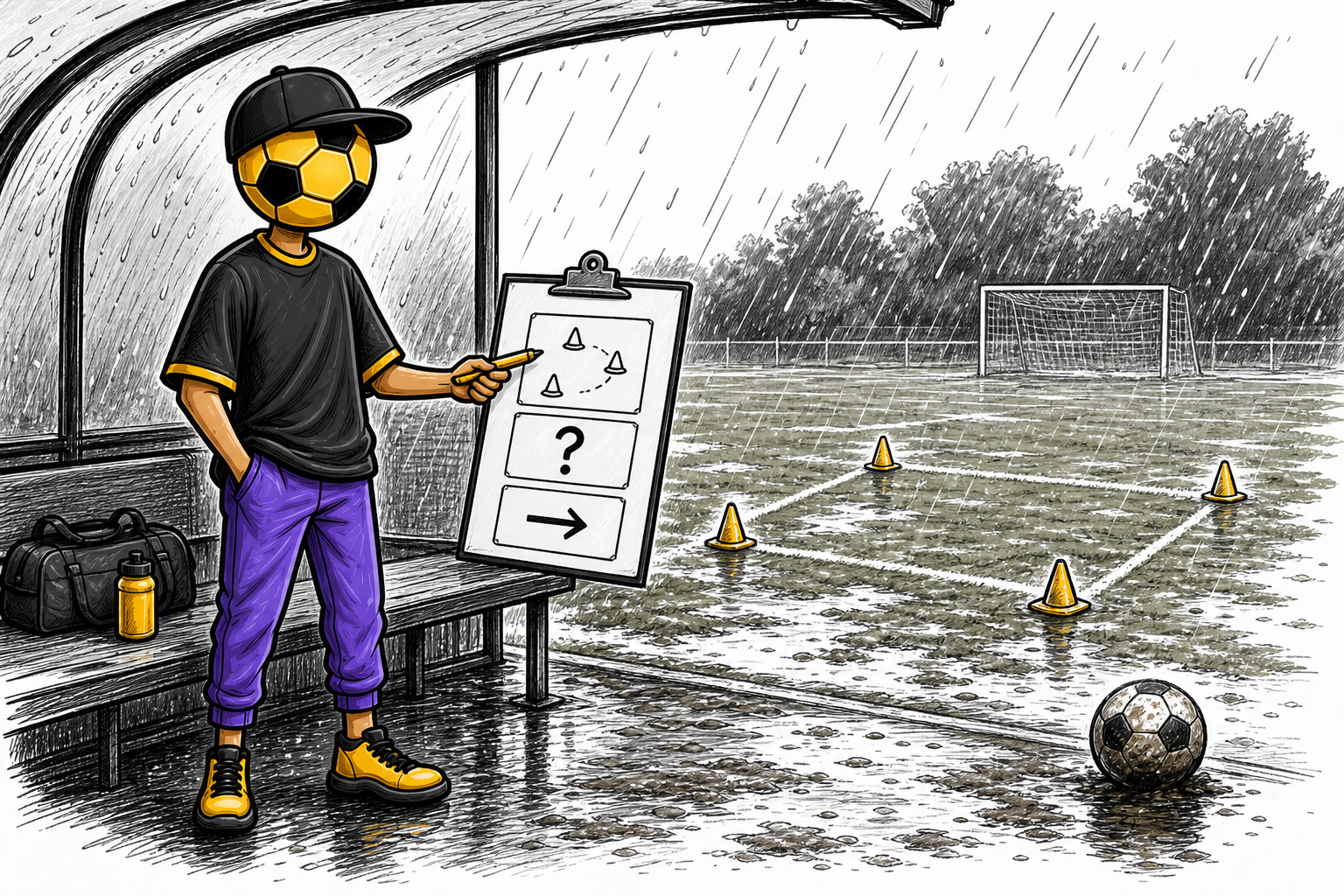
Version two: same rain, same kids, but at some point in the week I've spent thirty seconds, genuinely about thirty seconds, deciding three things.
First, a shape. One theme for the morning, small enough to survive the rain. Not "attacking play". Something like: first touch out of your feet. The warm-up points at it, the drill points at it, and when we play the match at the end, that's the thing I'm watching for and shouting about. One thread, start to finish. The session suddenly has a spine, and weirdly, the kids feel it. Sessions with a spine are calmer. There's less messing about because there's less vacuum to mess about in.
Second, a question to ask each kid. Just one, and it does two jobs at once. "What are you working on today?" tells me instantly whether the theme has landed or bounced straight off. And it means every child gets one moment of the coach's full attention with their name on it, including, especially, the quiet ones at the edge of the drill who can otherwise pass through a whole morning untouched by an adult's interest. Fifteen kids, fifteen questions, maybe three minutes of my morning. It's the highest-value three minutes I spend.
Third, a next step to give. Each kid leaves with one small, specific thing. "Next week, try taking that touch on your weaker side." Not a lecture, one sentence. Because here's what I learned the slow way: kids don't remember sessions, they remember what you told them about themselves. A next step turns this Sunday into a thread that reaches next Sunday. Without it, every week is episode one again.
That's the whole thing. A shape, a question, a next step. Thirty seconds of deciding, and 9am in the rain stops being something you survive and becomes something you deliver.
I want to be clear about what I'm not saying. I'm not saying volunteer coaches are lazy. The opposite. The parents I coach alongside give up their evenings and weekends for other people's children and pay for the petrol themselves. The wing-it sessions don't happen because people don't care. They happen because nobody ever showed us the thirty-second version of preparation. The courses talk about session planning like it's homework: templates, objectives, boxes. Real life doesn't have room for homework. It has room for a shape, a question and a next step, decided in the car if it has to be.
The kids can't tell you the difference between an improvised session and a coached one. But they feel it, and over a season it compounds into the difference between a kid who drifts off and a kid who can tell you what they got better at this year.
So that's my challenge for your next wet Sunday. Before you leave the house: what's the shape, what's the question, what's the next step? Thirty seconds. See what it does by Christmas.
Read more from SHOT.